

Project Aims
Introduction
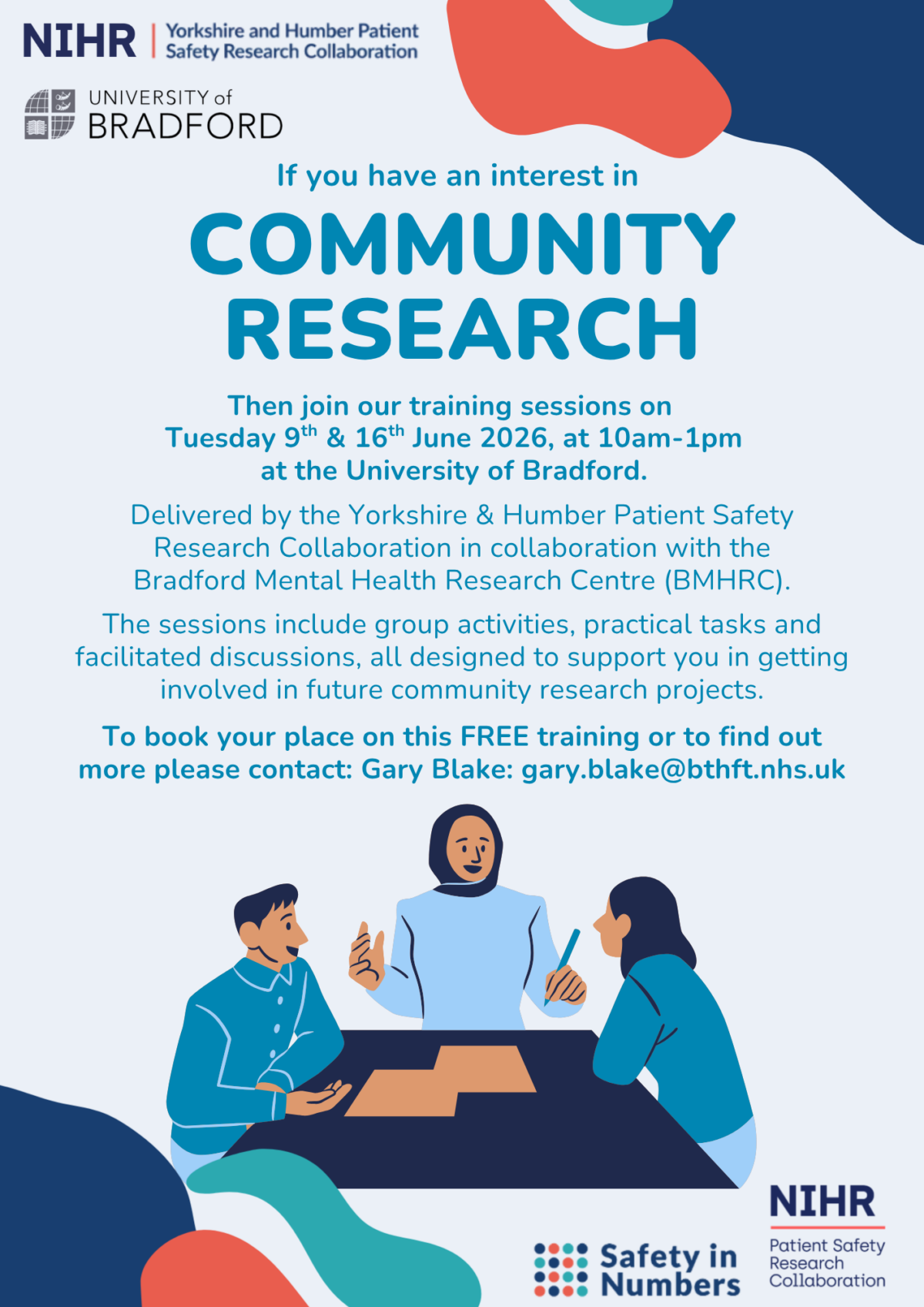
This training has been developed and is being delivered through a partnership of the Yorkshire and Humber Patient Safety Research Collaboration (PSRC) and the Bradford Mental Health Research Centre (BMHRC). It is for people who have an interest in, or have some experience of, community research.
Participants completing the training will have future opportunities to collaborate in community research projects through Yorkshire & Humber PSRC and the BMHRC. Details about this will be shared with participants on the training.
Outline of the training
Three different researchers from the Yorkshire and Humber Patient Safety Collaboration (PSRC) will be facilitating this training. The training will be delivered in a participatory way and will include group activities, tasks and facilitated discussions.
The training is for people who may have some previous experience of research, but also for people that may have an interest in research but no previous experience.
Session One: Tuesday 9 June 10.00am – 1.00pm.
Facilitated by Alison Bravington & Gary Blake
- Introductions, setting expectations and sharing experiences.
- The ‘typical’ researcher: research skills body map.
- Mapping the research process.
- The difference between qualitative and quantitative research.
- Spotlight on qualitative research questions, data collection and analysis.
- Identifying 30-minute activity for next week’s session.
- Opportunities to be involved in research.
Session Two: Tuesday 16 June 10am – 1.00pm.
Facilitated by Ed Breckin and Gary Blake
- Reflection on previous week’s training.
- Understanding inequities and Safety Inequities in research
- How research can address these.
- 30-minute activity on subject identified by participants in session one.
- The research life cycle.
- What happens after the project ends?
- Sharing your findings, with who and how?
- Next steps
Short Bios of Training Facilitators
Alison Bravington: Alison works as a Senior Research Fellow with the PSRC’s ‘decluttering’ team who are helping to remove or reduce tasks from healthcare that staff feel are a waste of their time and don’t benefit patients. Alison trained in psychology, social research, and evaluation methods, and has worked in health research for sixteen years in hospitals, hospices and community care. Most of her research has been with cancer patients, hospice patients, and the healthcare professionals who look after them, helping to improve communication and shared decision-making.
Ed Breckin: Ed is a Research Fellow working within the ‘Supporting Safe Care in the Home’ theme of the Yorkshire and Humber Patient Safety Research Collaboration (YH PSRC). Ed has worked with the Yorkshire Quality and Safety Research (YQSR) group since 2022, when he joined to work on the Partners at Care Transitions (PACT) study. He has worked for the NHS for over 10 years and completed his PhD on alleviating organised crime in Mexico in 2022.
Gary Blake: Gary currently works as a Community Engagement and Participation Lead (Yorkshire & Humber PSRC) and in 2024 he successfully completed a Research Fellowship around Health Inequities. He has more than 30 years’ experience of working in the Voluntary & Community Sector (VCS) and has experience of delivering a wide range of training including community development, community research, supporting volunteers and cultural competency and humility. He is currently a lead researcher on a project around improving young people’s experiences of health care appointments, has led a research project around young people’s experiences of not being in education, employment or training (Neet) and co-ordinated a national research project looking at people’s experiences of living with working-age poverty.
To book your place on this FREE training or to find out more please contact:
Gary Blake: gary.blake@bthft.nhs.uk
We want people not to be out of pocket for attending this training and will reimburse agreed expenses needed to participate in this training.
A free lunch for participants will be provided at the end of each session.
Keeping in touch
- Get Involved – Safety In Numbers: Join our SING (PSRC) network to be kept in touch about future Community Research training and patient safety research.
- Follow the YQSR Instagram to be kept up to date about patient safety research.
- Follow the BMHRC on LinkedIn!